
What does four years of war feel like?
In a single word, exhausting. Not dramatic exhaustion, not a difficult month or even a difficult year, but the slow and cumulative depletion of endless sleepless nights, constant stress, and constant loss. This last winter in particular, the simple fight to keep warm, to keep the lights on, to keep functioning as human beings, pushed many of us to the very edge of endurance.
So much has become normal that should never have been normalised.
At the beginning, the sound of a single alarm would send people running for shelter, and the threat of one Shahed drone felt overwhelming. Now we try to sleep through volleys of cruise and ballistic missiles, sometimes hundreds at a time, raining down on our city. Before a predicted night attack, we fill jugs and saucepans with water in case the pumps fail, and we charge battery packs so that, in the morning, we can continue some semblance of work and routine. Evenings are measured by percentages of remaining power before we are plunged back into darkness.
Over these four years, I have lost something. Not hope, and not purpose, but fear.
You cannot react to every alarm and still function. If we ran to shelter each time the siren sounded, we would never sleep, never work, never live. So you adapt. You absorb it. You grow used to what should be intolerable.
I remember my first night in Ukraine after the full-scale invasion. I was alone in Lviv when the alarm sounded, and I had no real understanding of what it meant or how imminent the threat might be. There were no reliable channels then explaining what was coming. A thunderstorm rolled over the city that night, and I lay awake trying to distinguish between thunder and impact. It was impossible. I will never forget that feeling of uncertainty.
Within days of arriving, I realised that I was not simply passing through. I had found the work I wanted to dedicate myself to, and the country I wanted to do it in.
One of the most memorable moments of the past four years was arriving in Kherson just days after its liberation. The city felt fragile but unbroken. Ukrainian flags hung from balconies, and strangers stopped us in the street simply to say thank you for coming. There was electricity only intermittently, little running water, and shelling in the distance, yet there was also something else entirely, relief, dignity, and freedom restored. Until that moment, I had thought of freedom primarily as a political concept. In Kherson, I understood that it is also an emotion, something visceral and tangible when it has been so bitterly won. At that time, we had little understanding of the horrors that were yet to befall the city.
After months of supporting the recovery of the city, I returned to the same place, this time rowing a boat through flooded streets after the destruction of the Nova Kakhovka dam. Apartment blocks stood in brown floodwater, possessions drifted past in the current, and people waved from upper floors as volunteers ferried supplies and evacuated residents, even as shells continued to fall nearby.
The same city, two momentous events, and still people stayed. They cleared mud from their homes, rebuilt what they could, cleaned the streets once the water receded, and drank coffee outside cafés while artillery shells flew overhead.
This war has had a tragic impact on the country I love so much. In four years, I have lost fifteen friends, acquaintances, and colleagues. That number is only a fraction of the loss carried by Ukrainian families who have buried husbands, wives, parents, and children, but compounded grief leaves its mark. It settles somewhere deep and becomes part of you.
The blackouts were another form of warfare. For long periods we had two hours of electricity a day. There was no possibility of cooking, no hot water, and no certainty about when power might return. Life narrowed to survival. In winter, the balcony became the freezer. The fridge was warmer than the air outside, so food sat on the windowsill because there was nowhere else to keep it. Evenings were spent in darkness, waiting for the irritating tune that the microwave produced that signalled electricity had returned. I both love and hate that irritating sound in equal measure.
And yet, life continues.
There are birthdays and dinners with friends. There is laughter in kitchens while air defence systems work overhead. Restaurants and bars with generators have become our places of survival, where the war can be forgotten or seem distant for a while. Cafés are full the morning after a major strike, and children walk to school past destroyed buildings and concrete barriers as though they have always been there. War becomes the background noise to ordinary life, not because it is accepted, but because life insists on continuing.
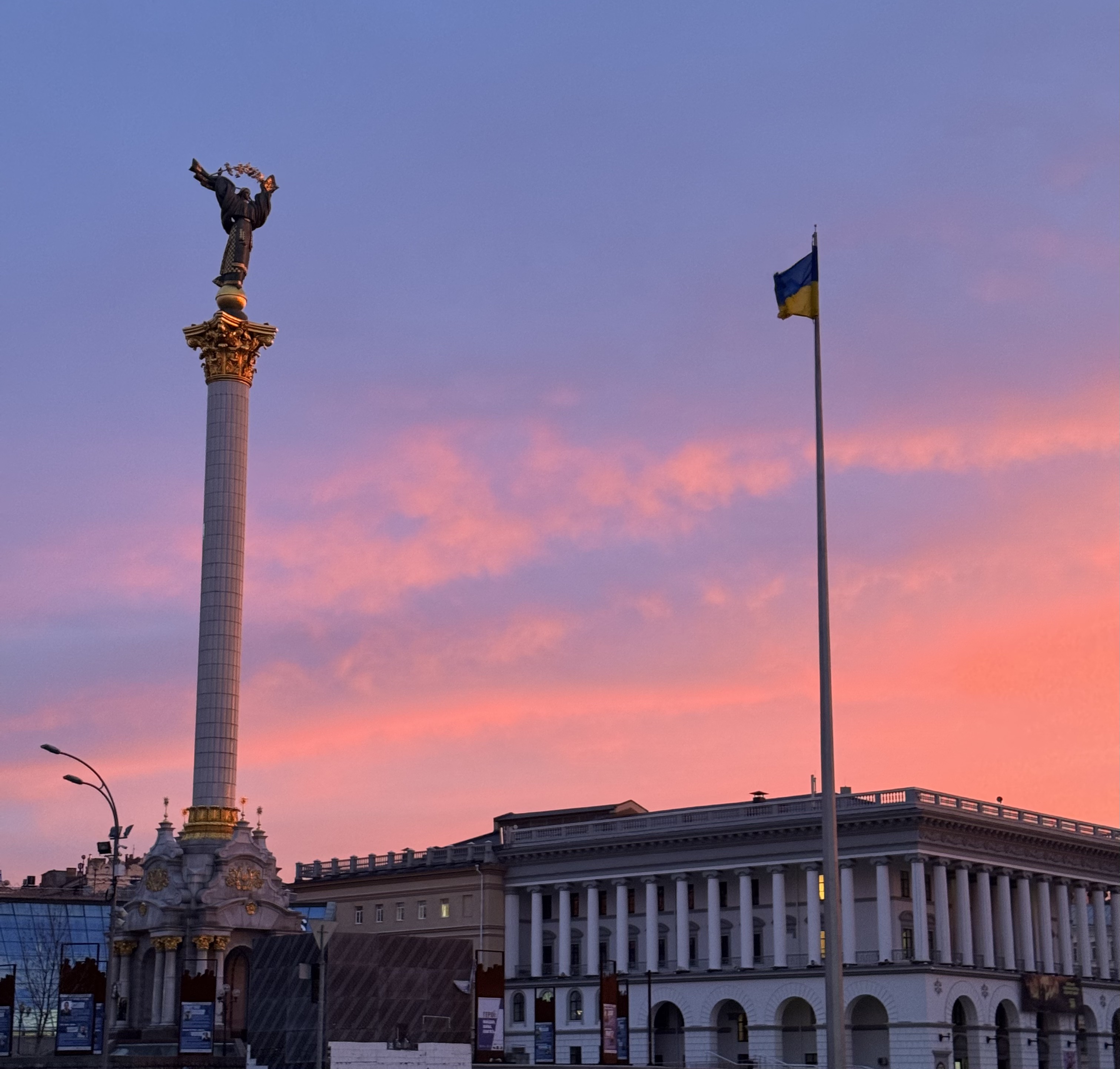
Four years on, Kyiv is my home.
I am a proud and defiant Kyivan, and I will remain so for decades to come. This city has tested endurance, demanded resilience, and revealed a depth of courage that humbles me every day I am privileged to walk her streets. Kyiv stands not because it has been spared, but because its people refuse to bend. To belong to this city, especially now, is something I carry with pride.
But my commitment is not only to Kyiv.
Ukraine has given me purpose, direction, and a sense of meaning that I did not fully understand until I found it here. I have seen extraordinary dignity in the face of devastation and a determination to rebuild that goes far beyond survival. This country has endured the unimaginable, yet it remains generous, stubborn, creative, and profoundly alive. Whatever the years ahead may hold, my passion for Ukraine and my belief in her future will not diminish.
These are the personal reflections of our Head of Mission after 4 years working in Ukraine.

Leave a Reply